The gist
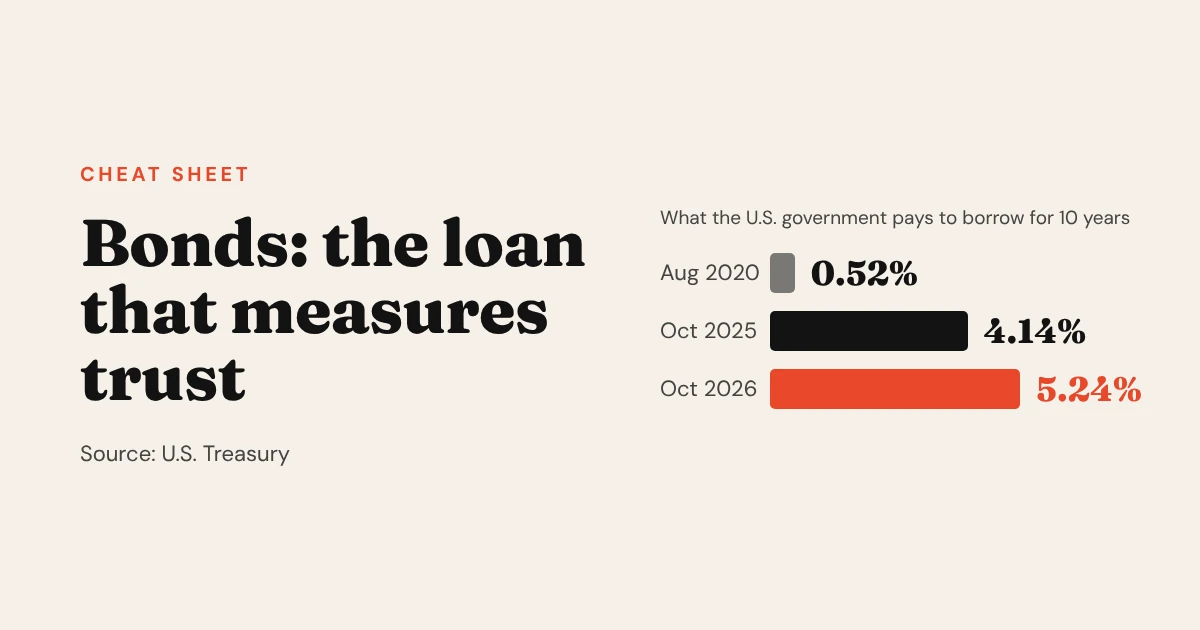
A bond is a loan you make to a government or company. The interest it pays (its "yield") works like a trust score. When lenders get nervous about inflation or a government's debts, they ask for more interest. On 9 October 2026, the U.S. government paid 5.24% a year to borrow for 10 years, up from 4.14% a year earlier and 0.52% in August 2020. That number quietly shapes your mortgage, car loan and savings rate.
Three words first
- Bond: an IOU. You lend money, you get interest along the way, and you get your money back on a set date.
- Coupon: the fixed interest the bond pays each year. It is set when the bond is first sold and does not change for the buyer after that.
- Yield: the interest you actually earn if you buy the bond at today's price. It's the word you'll hear on the news; think of it as "the bond's real interest rate."
How a bond works
| Part | Plain meaning | Example |
|---|---|---|
| Face value | What you get back at the end | $1,000 |
| Coupon | Fixed yearly interest | 5% = $50 a year |
| Maturity | When you get your money back | 2, 10 or 30 years |
| Price | What it sells for today between investors | $900 to $1,100 |
| Yield | The interest you earn at today's price | $50 ÷ $900 ≈ 5.6% |
The one rule: price down, interest up
When a bond's price falls, the interest you earn on it rises. Here's why.
- The coupon is locked in. Most bonds pay the same fixed amount until the end date, no matter what happens to interest rates later. (Some special bonds float with rates or inflation, but most don't.)
- New bonds follow today's interest rates. Say you own an old bond paying $50 a year. Then interest rates rise, and new bonds pay $60 a year for the same $1,000.
- So the old bond has to get cheaper. Nobody pays $1,000 for $50 a year when they can get $60 elsewhere. The old bond only sells if its price drops, to about where its $50 earns as much as the new bonds do.
- It works the other way too. If interest rates fall, old bonds paying more than new ones become popular, and their price rises.
So your interest isn't changed by the government: your coupon stays the same. What changes is the bond's price, and with it the interest a new buyer earns.
Why the 10-year yield matters to you
The 10-year U.S. government bond is the number to watch, because other loans are priced from it.
- Lending to the U.S. government is the safest loan there is. So it sets the floor: anyone lending to you has to earn more than they'd get from the government.
- A mortgage is a long loan to a riskier borrower (you). So banks charge the 10-year yield plus extra for the risk. When the 10-year yield rises, 30-year fixed mortgage rates tend to rise with it.
- The same goes for business loans and for what the government pays on new debt.
Higher borrowing costs don't hit everyone the same way. Our K-shaped economy cheat sheet shows who gains and who gets squeezed.
What yields say about trust
| Signal | What it usually means |
|---|---|
| Yields low and steady | Lenders trust the government and expect prices to stay calm. |
| Yields rising across the board | Lenders fear inflation, or expect the central bank to keep interest rates high. |
| Long-term yields above short-term | Lenders want extra pay for waiting, often because they worry about debt or inflation years from now. |
| One country's yields rising faster than its neighbours' | Lenders doubt that government's finances, so they charge that government more interest than its neighbours. |
| Short-term yields above long-term (an "inverted curve") | Markets expect that country's economy to slow and its central bank to cut interest rates. |
Where the U.S. stands (9 October 2026): 4.80% for 2 years, 5.24% for 10 years, 5.60% for 30 years. Long-term yields are above short-term, and the 10-year is more than a full percentage point higher than a year ago. That's high by recent standards: lenders are charging the U.S. government more to wait.
Three things worth checking this week
- The 10-year Treasury yield. It moves with mortgage rates. Look it up once a week and you'll see rate changes coming.
- Your savings rate. If your savings account pays near 0% while the government pays 4.80% to borrow for 2 years, the bank is keeping the difference.
- The news, with new eyes. Next time you read "yields jumped," translate it: lenders want more interest, so borrowing is about to get more expensive.
Why nobody told you this
Most of us were taught that shares are "the market" and bonds are boring. But the bond market sets the price of borrowing for everyone, governments included. Reschooled's short video lessons explain how money and the economy really work, at reschooled.life.
Sources
- U.S. Department of the Treasury, Daily Treasury Par Yield Curve Rates: 9 October 2026 (2-year 4.80%, 10-year 5.24%, 30-year 5.60%); 9 October 2025 (10-year 4.14%); 4 August 2020 (10-year 0.52%).
- Arithmetic: $50 coupon ÷ $900 price = 5.56%.
Educational content, not financial advice.