The gist
Time preference is how much you prefer having something now over having it later. Everyone has some; it's human. But how patient people are depends a lot on whether the reward for waiting feels reliable. In one well-known study, children waited about four times longer for a second treat when the adult running it had kept an earlier promise. Money works the same way: if the money you save keeps its value, waiting pays off. If it loses value every year, the system nudges you to spend sooner.
Three words first
- Time preference: how strongly you prefer now over later. "High" time preference means you want it now. "Low" means you're happy to wait for more.
- Present bias: the habit of being extra impatient about the very near future. We are fairly patient about next year versus the year after, and very impatient about today versus next week.
- Purchasing power (aka real value): what an amount of money can actually buy, after prices change. $100 in a drawer stays $100, but its real value falls when prices rise.
The $15 question
In 1981 the economist Richard Thaler asked people a simple question: what amount would make you just as happy as getting $15 today?
| Wait | Typical answer | What that implies, per year |
|---|---|---|
| 1 month | $20 | about 345% |
| 10 years | $100 | about 19% |
Look at the first row. Asking for $5 extra to wait one month means acting as if waiting costs you hundreds of percent a year. Over ten years, the same people were far more patient. That gap is present bias: the closer the reward, the harder it pulls.
Nobody is being stupid here. "Now" is certain. "Later" comes with questions: will the money still be there, will it still buy the same things, will I still want it?
The marshmallow test, retold
You may have heard of the marshmallow test. In experiments that began around 1970, psychologist Walter Mischel offered young children one treat now, or two if they could wait alone for a while. Later research linked the waiters to better results as teenagers, and the story became "willpower predicts success."
Two newer studies change that story.
1. The link is smaller than we thought. In 2018, researchers repeated the idea with more than 900 children from a broad U.S. study. Children who waited did tend to have stronger maths and reading scores in their teens, but the link was small, and it largely disappeared once the researchers took the children's family background and early environment into account.
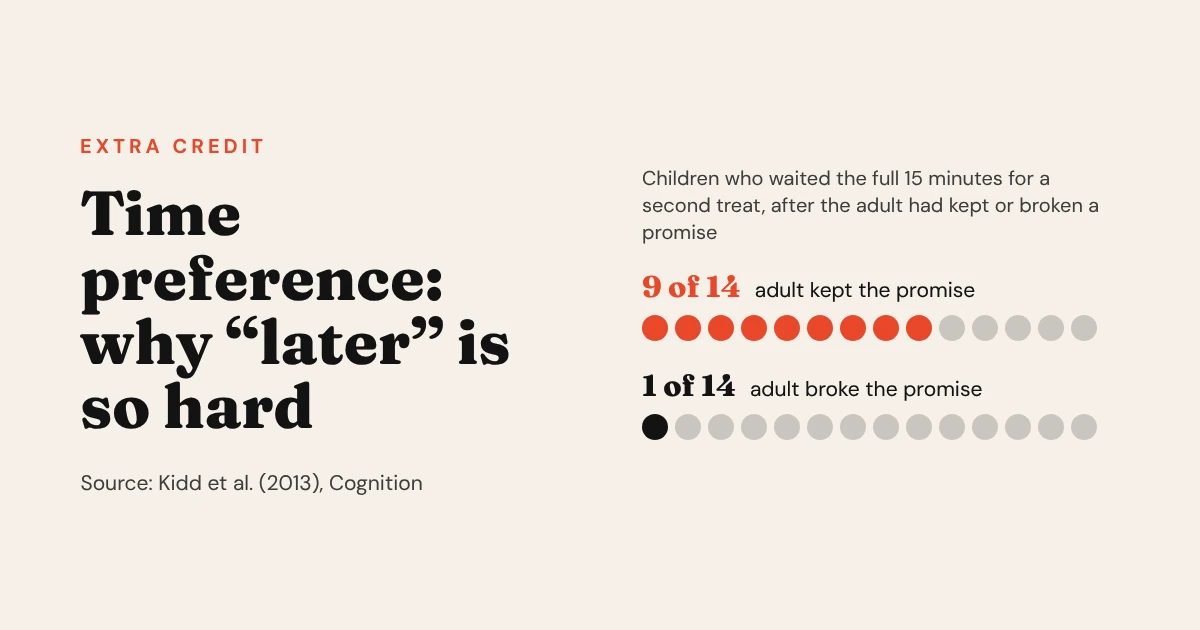
2. Waiting depends on trust. In a 2013 study at the University of Rochester, 28 children aged three and a half to almost six first took part in an art project. The adult running it promised them a new set of art supplies instead of some well-used crayons if they waited.
- For half the children, the adult came back with them, as promised.
- For the other half, the adult came back empty-handed and apologized.
Then came the marshmallow.
| The adult had been... | Average wait | Waited the full 15 minutes |
|---|---|---|
| Reliable | about 12 minutes | 9 of 14 children |
| Unreliable | about 3 minutes | 1 of 14 children |
Same age, same treat, same room. The difference was whether waiting had paid off before. The children who ate the marshmallow quickly weren't lacking willpower. They had just learned that promises about "later" might not hold.
Your money is a promise about later too
Every dollar, euro or pound you save is a bet that it will still buy something later. When prices rise, that bet loses a little each year.
In the U.S., consumer prices rose 3.7% in the 12 months to September 2026 (Bureau of Labor Statistics). The Federal Reserve's own long-run goal is 2% a year. Here is what $100 kept as cash would buy, in today's prices, if each rate simply continued:
| Prices rise each year by | After 5 years | After 10 years | After 20 years |
|---|---|---|---|
| 2% (the Fed's goal) | $90.57 | $82.03 | $67.30 |
| 3.7% (the latest year) | $83.39 | $69.54 | $48.35 |
This is the marshmallow test with money. If the reward for waiting shrinks while you wait, waiting starts to feel like the "unreliable adult" condition. Spending now, borrowing now, or chasing quick returns can look more sensible than saving.
Economists disagree about how much this matters, and both sides are worth knowing:
- The "hard money" argument. Economists of the Austrian school, going back to Eugen von Böhm-Bawerk and Ludwig von Mises in the late 1800s and early 1900s, put time preference at the centre of how they explain interest and saving. Many of their followers argue that money which keeps losing value pushes a whole society toward a higher time preference: more spending and borrowing, less saving and long-term building.
- The mainstream view. Most central banks, including the Federal Reserve, aim for low, steady inflation of about 2% a year rather than zero. They argue that a little predictable inflation is healthy for the economy, and that what really hurts people is inflation that is high or unpredictable.
Either way, the practical lesson is the same: what you save in only keeps rewarding your patience if it at least keeps up with prices.
Where interest comes in
The American economist Irving Fisher wrote a whole book on this in 1930, The Theory of Interest. His short version: "The impulse of a man to spend is caused by his impatience." Interest is the reward for being patient: you hand over money now, and get more back later.
So the useful question about any savings account is: does the reward beat rising prices?
- Savings at 0.5% a year while prices rise 3.7%: your money loses about 3.1% of its purchasing power each year.
- Savings at 4% a year while prices rise 3.7%: your money gains about 0.3% of purchasing power each year.
The number on the statement goes up in both cases. Only one of them is a real reward for waiting.
Bitcoin and the "savings technology" idea
Bitcoin enters this conversation for one reason: its code limits the total supply to 21 million coins, and nobody can print more. Supporters argue that money with a fixed supply rewards waiting over the long run, which is why some people call it a savings technology.
Two honest caveats. First, its price can swing a lot over weeks and months, which is the opposite of a reliable reward in the short term. Second, nobody can promise what it will be worth in the future. If you want to understand it, learn how it works before you put a cent into it. This article explains an idea and is educational; it is up to you to decide whether to buy anything. Or not.
How to make waiting easier
You don't have to fight present bias with willpower alone. Design around it. One thing first, after everything above: waiting only pays if the reward keeps its value. Parking money in an account that pays less than inflation is waiting for the "unreliable adult". So these tips are about setting money aside for later in a place where the reward for waiting is real, not about piling up cash that quietly buys less each year.
- Commit your future self, not your present self. In the "Save More Tomorrow" program designed by Richard Thaler and Shlomo Benartzi, employees agreed in advance to put part of their future pay rises into their retirement plan. Their average saving rate rose from 3.5% to 13.6% over 40 months. Setting aside money you don't have yet doesn't feel like a loss.
- Make it automatic. Move money for later on payday, before you see it. Every decision you don't have to make is one present bias can't win.
- Make the reward reliable. Like the children with the reliable adult, you wait more easily when you trust the payoff. Before you choose where money waits, compare what it earns with inflation (the check below). If the answer is below zero, waiting there costs you, so look for something that at least keeps up with prices.
- Make "later" concrete. "Saving" is vague. "A deposit for a flat in four years" is something you can picture, and a clear goal also tells you how long the money will wait and where it should wait.
Three things worth checking this week
- Your real savings rate. Find the interest rate on your savings and subtract the latest inflation rate. Is the result above zero?
- Your next raise. Decide now what share of it goes straight to savings, before it arrives.
- Your "now" spending. Pick one recurring purchase and ask: would I still choose this if the money I saved instead kept its value?
Why nobody told you this
School teaches you to wait for the bell, not why waiting pays, or when it doesn't. Reschooled is a short video course ($9.99) on the money and life skills school never taught us, starting with why your money loses value. Find it at reschooled.life.
Sources
- Thaler, R. (1981). "Some empirical evidence on dynamic inconsistency." Economics Letters 8, 201–207. $15 today vs $20 in one month (implied about 345% a year) and vs $100 in ten years (about 19% a year), as summarized in MIT OpenCourseWare 14.13 Economics and Psychology, lecture notes on time discounting.
- Kidd, C., Palmeri, H. & Aslin, R. N. (2013). "Rational snacking: Young children's decision-making on the marshmallow task is moderated by beliefs about environmental reliability." Cognition 126(1), 109–114. 28 children (14 per condition): average wait about 12 minutes (reliable) vs about 3 minutes (unreliable); 9 of 14 vs 1 of 14 waited the full 15 minutes.
- Watts, T. W., Duncan, G. J. & Quan, H. (2018). "Revisiting the Marshmallow Test." Psychological Science. More than 900 children; small association with adolescent achievement that largely disappeared after controlling for family background and early environment (Association for Psychological Science summary).
- U.S. Bureau of Labor Statistics, CPI news release for September 2026 (14 October 2026): all items up 3.7% over 12 months.
- Federal Reserve, "Why does the Federal Reserve aim for inflation of 2 percent over the longer run?" (FAQ).
- Fisher, I. (1930). The Theory of Interest, Chapter I ("The impulse of a man to spend is caused by his impatience"), via FRASER, Federal Reserve Bank of St. Louis.
- Thaler, R. & Benartzi, S. (2004). "Save More Tomorrow." Journal of Political Economy 112(1). Average saving rate from 3.5% to 13.6% over 40 months (Chicago Booth summary).
- Bitcoin Core: total supply capped at 21 million.
- Arithmetic: $100 ÷ (1 + rate)^years. 2%: $90.57 / $82.03 / $67.30; 3.7%: $83.39 / $69.54 / $48.35. Real return ≈ (1 + savings rate) ÷ (1 + inflation) − 1: 0.5% → −3.1%; 4% → +0.3%.
Educational content, not financial advice.