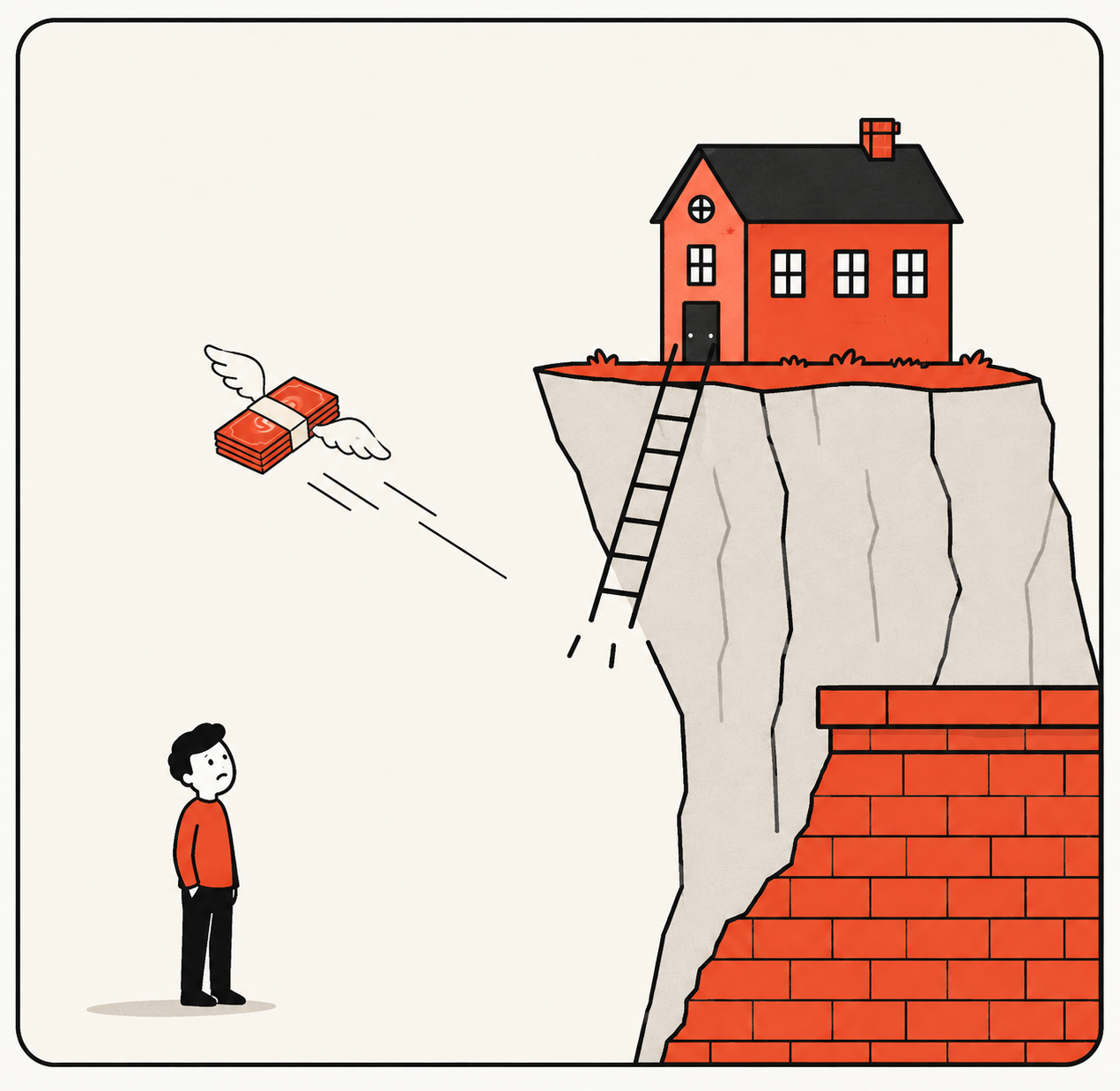
Somewhere along the way you were handed a set of instructions for building a good life. Save a portion of what you earn. Get a steady job and work your way up. Buy a house as soon as you can, because property only goes up. Stay in school, get the grades, and the rest will follow.
This was not bad advice. It was sincere advice, given by people who loved you and, in most cases, had watched it work with their own eyes. Your parents saved and it grew. They bought a house and it made them wealthy. They worked hard and got ahead. So they told you to do the same.
The trouble is not that the advice was foolish. The trouble is that it was written for a version of the economy that no longer exists. The rules changed underneath it, quietly, over decades. And nobody updated the instructions.
Here is what changed, one piece of advice at a time.
“Save your money”
Start with the most basic lesson of all: put money aside, and you will be better off later.
For most of the twentieth century this was simply true. Money held its value reasonably well, and a savings account paid you enough interest to stay ahead. Saving was a way of moving value from today into tomorrow.
To see why that stopped working, you need one piece of vocabulary that school probably skipped: purchasing power. It means what your money can actually buy. $10 in 2000 bought more than it buys today. The number on the note is identical. The bread, rent, and fuel it gets you is not.
Today, money in a standard savings account loses purchasing power almost every year. The interest you earn sits below the rate at which prices rise, so the balance grows on paper while it shrinks in real terms. You are not being paid to save. You are being slowly charged for it. The most cautious, responsible thing your parents told you to do has quietly become one of the worst places to keep long-term wealth. Not because you did anything wrong, but because the money itself is designed to lose value over time. Why it is designed that way is the mechanism the Reschooled course takes apart in detail.
The instruction was right. The tool it was written for changed.
“Get a steady job and work your way up”
The second lesson was about effort. Find secure work, be reliable, put in the years, and your standard of living will rise with them.
For your parents' generation, effort and reward were tightly linked. Wages rose in real terms across the post-war decades. A single income could support a household, a mortgage, a car, and a holiday. Working harder genuinely meant living better.
That link has been fraying for a long time. In the UK, real wages — what your pay actually buys after inflation — stagnated for more than fifteen years after the 2008 financial crisis, and the inflation surge of 2022 knocked them back to roughly where they stood in 2003. (Economics Help) Two decades of nominal raises, erased in purchasing power. Around 65% of middle-class US households now report that their income is falling behind the cost of living. (Primerica, 2026)
You are not imagining the treadmill. You can do everything your parents did: show up, work hard, stay loyal, and still find yourself running to stand still. The effort is the same. The reward it buys is not.
“Get on the property ladder as soon as you can”
This was the crown jewel of the advice. A house was the safe bet, the forced savings plan, the thing that made ordinary families wealthy without them having to understand finance at all. Buy early, hold on, and let it grow.
Look at what the ladder actually costs now.
In the 1970s, the average UK home cost around 3.5x the average salary. (Avocado Property) Today it is closer to 9.5x. The rung did not move up a little. It moved into a different building.
In the United States, the story is written in the age of the buyers. The typical first-time homebuyer was 29 in 1981. In 2025 they were 40, a record high in more than four decades of data, and first-time buyers made up just 21% of the market, the lowest share ever recorded, down from around 40% before 2008. (National Association of Realtors, 2025) An entire generation is not choosing to buy later. It is being kept out until later, if ever at all.
And here is the cruelty in it. The advice — buy a house, it goes up — is still technically true. Houses do go up. That is exactly the problem. They rise faster than wages can chase, so the very appreciation that made your parents wealthy is the thing now locking you out. The house did not get better. The money used to price the house got weaker. But the deposit you need got bigger anyway.
To get a sense of what this looks like over time, we recommend checking out this calculator. Spoiler alert: it may freak you out. It shows how much more a home costs when priced in fiat, and how that same home looks when priced in a form of money that isn't being diluted. Try the Bitcoin purchasing-power tool →
For those who inherited a home or bought one before the doors closed, the ladder worked as promised. For everyone told to climb it today, the promise and the price no longer match.
“Stay in school, get the grades, and you'll be set”
Which brings us to the advice this whole piece is really about. The one that came from your teachers as much as your parents. Do well at school, and you will be equipped for life.
School taught you a great many things. Trigonometry. The water cycle. Perhaps, on a good day, compound interest. What it almost certainly never taught you was who actually creates the money in your account, why that money loses value every year, or what happens to ordinary savers when the system that manages it reaches its limits.
That is not a small omission. It is arguably the single most important financial fact of your adult life, and it was left out of thirteen years of education entirely. You were sent into an economy built on money you were never taught to understand, and then told that any struggle within it was a personal failing, a matter of discipline, of the coffees and the holidays.
It was not a discipline problem. It was a curriculum problem.
Not to mention an economic design problem. The one lesson that would have explained everything else was the one nobody gave.
Why all of it worked then, and stopped working now
None of this means your parents were lucky fools or your teachers were negligent.* They lived through, and taught from, a genuinely different era.
The generation that handed you this advice came of age during one of the greatest expansions of shared prosperity in modern history. Wages rose. Housing was affordable relative to income. Assets such as homes, pensions, and stock portfolios climbed steadily through the 1980s and 1990s, quietly making a whole generation wealthy. In that world, the instructions worked because the world obeyed them.
Then the ground shifted. The share of Americans who count as middle class fell from 61% in 1971 to 51% by 2023. (Pew Research) That starting date is not chosen at random, and the Reschooled course explains exactly why it marks the turning point. The short version: the money changed, and everything measured in money — houses, wages, savings, the distance between owning assets and merely earning a wage — changed with it. The advice stayed frozen in the old world while the economy walked into a new one.
Your parents felt the first tremors of this. You are living inside the full result. That is the entire difference between their experience and yours, and it explains almost everything that feels unfair about money today.
This is the part school skipped
If you have ever felt that you are doing everything right and still falling behind, read this carefully: you probably are doing everything right. You are following instructions that were accurate, given in good faith, by people who watched them work. The instructions simply expired, and no one issued a correction.
That is not a reason to panic. It is a reason to finally learn the lesson that was left out: how money actually works, why it behaves the way it does, and what that means for the decisions in front of you now.
That is what Reschooled is for. Not to frighten you, and not to tell you your parents were wrong. To hand you the chapter of the instructions that was missing all along, so that for the first time, you are playing by the rules of the game as it is actually played today.
* Or perhaps the education system is an entirely other story for another day. We have our opinions on that too.