The gist
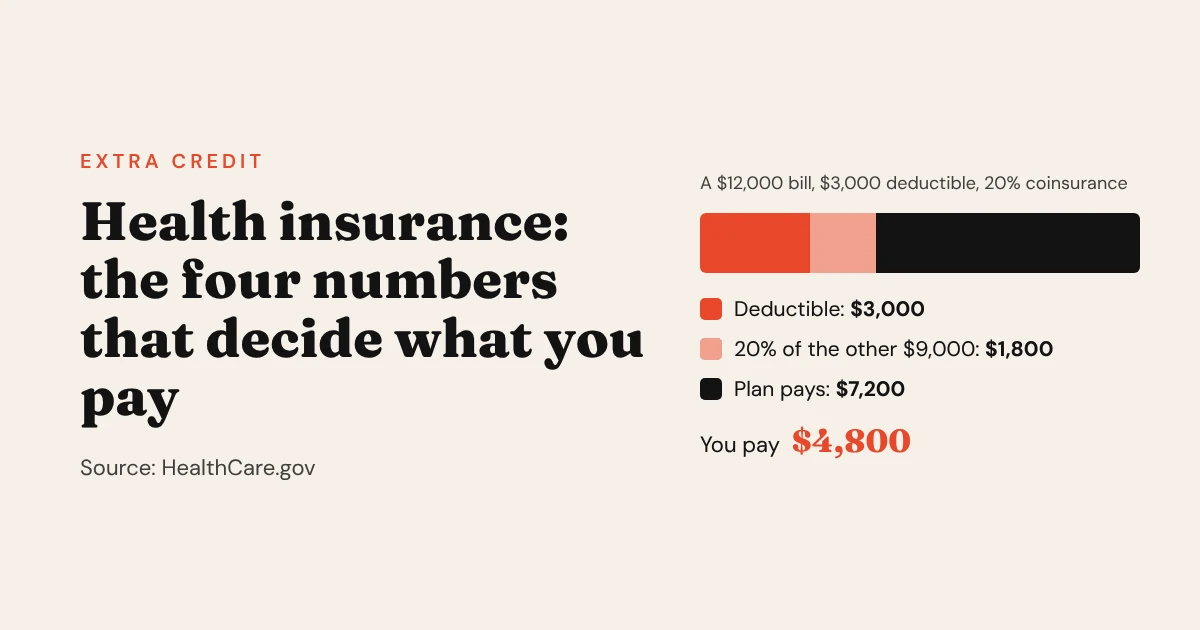
What you pay for health insurance is more than the monthly price. It is the monthly price plus your share of every bill. Four numbers decide that share: the premium, the deductible, the coinsurance and the out-of-pocket maximum. Example: on a plan with a $3,000 deductible and 20% coinsurance, a $12,000 bill for covered care costs you $4,800. Learn these four words and you can read any plan.
The four words
All four definitions come from HealthCare.gov, the U.S. government's health insurance site.
- Premium: what you pay every month to have the plan. You pay it whether you use any care or not.
- Deductible: what you pay for covered care first, before the plan starts to pay. With a $2,000 deductible, you pay the first $2,000 of covered services yourself.
- Coinsurance: after the deductible, your share of each bill as a percentage, for example 20%. The plan pays the rest. (Some services use a copayment instead: a fixed amount, like $20 for a doctor visit.)
- Out-of-pocket maximum: the most you pay for covered in-network care in a plan year. Once your deductible, copayments and coinsurance add up to it, the plan pays 100% of covered costs for the rest of the year.
Follow one bill
This is HealthCare.gov's own example. The plan has a $3,000 deductible and 20% coinsurance. You need a lot of treatment, and the bill for covered care is $12,000.
| Step | You pay | The plan pays |
|---|---|---|
| The first $3,000 (your deductible) | $3,000 | $0 |
| The other $9,000, split 20% / 80% | $1,800 | $7,200 |
| Total | $4,800 | $7,200 |
Now a small bill on the same kind of plan. A doctor visit costs $100 and your coinsurance is 20%. If you haven't reached your deductible yet, you pay the full $100. If you have, you pay $20.
That is why the same visit can cost very different amounts in January and in November.
The safety net: the out-of-pocket maximum
The out-of-pocket maximum is the number that protects you in a very bad year. For 2026 plans bought on the Marketplace (the Health Insurance Marketplace: a government service where people shop for and enroll in health insurance, run by the federal government at HealthCare.gov for most states, while some states run their own), it can be no more than $10,600 for one person and $21,200 for a family. It counts what you pay in deductibles, copayments and coinsurance, not your monthly premiums.
Why the cheapest monthly price isn't always the cheapest plan
Marketplace plans come in metal levels. On average, a Bronze plan pays about 60% of the costs of covered care and you pay about 40%, and the deductible is generally high. A Platinum plan pays about 90%, you pay about 10%, and the deductible is generally low.
Here is a simplified, made-up comparison to show the idea. These plans are hypothetical; real plans have more parts (copayments, tax credits, networks).
| Plan A | Plan B | |
|---|---|---|
| Premium | $300 a month | $450 a month |
| Deductible | $5,000 | $1,500 |
| Coinsurance | 30% | 20% |
| Out-of-pocket maximum | $9,000 | $5,000 |
| A quiet year (no care): premiums only | $3,600 | $5,400 |
| A big year ($12,000 bill): premiums + your share | $3,600 + $5,000 + $2,100 = $10,700 | $5,400 + $1,500 + $2,100 = $9,000 |
In a quiet year, Plan A is $1,800 cheaper. In a big year, Plan B is $1,700 cheaper. Neither is "the best plan". The right one depends on how much care you expect to use and how big a bill you could cover if something happened.
Is it the same in other countries?
No. Everything in this article describes the U.S. system. Many other countries pay for most health care through taxes or compulsory public insurance, so the words are different and what you pay yourself at the doctor or hospital can be much lower, or work in a different way. If you live outside the U.S., check how your country's public health system or your insurer splits the costs. The idea still travels: always look past the monthly price to what you'd pay in a bad year.
Three things worth checking this week
- Find your four numbers. Your plan's Summary of Benefits and Coverage lists the deductible, copayments, coinsurance and out-of-pocket maximum.
- Check what you've already paid this year. Your insurer's app or website usually shows how close you are to the deductible and the out-of-pocket maximum.
- Ask "in-network?" before you book. The out-of-pocket maximum applies to covered, in-network care.
Why nobody told you this
Insurance is one of those things school skips. Then life hands you a form and a deadline. Reschooled is a short video course ($9.99) on the money and life skills school never taught us. Find it at reschooled.life.
This article is education, not financial, legal or medical advice. U.S. figures. Sources: HealthCare.gov glossary (premium, deductible, coinsurance, copayment, out-of-pocket maximum/limit, Marketplace); HealthCare.gov, health plan categories.