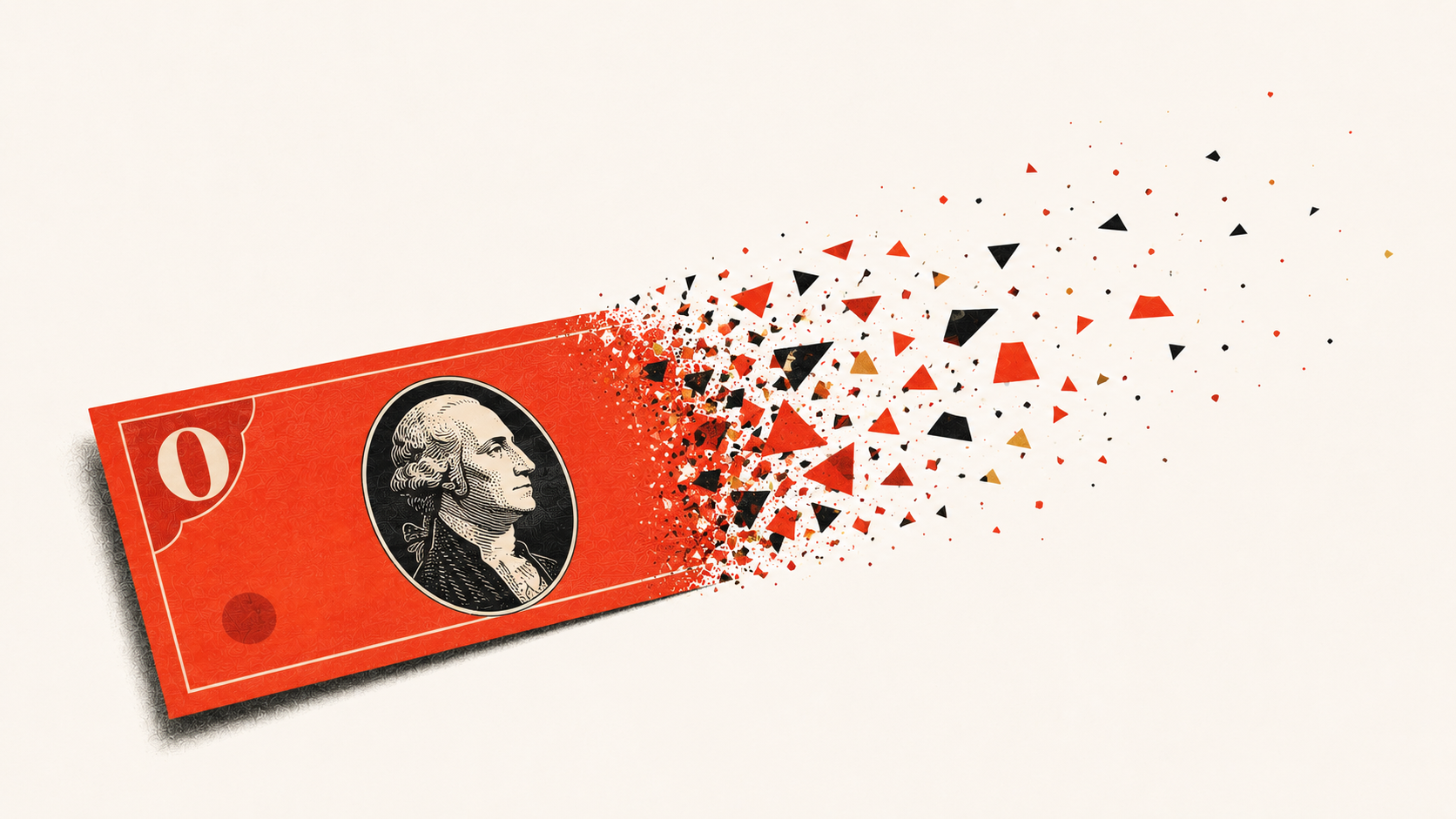
The word "fiat" comes from Latin. It means "let it be done." That is an apt name for modern money, because fiat currency is not backed by anything physical. It is backed by a government decree. An official declaration that this piece of paper, or this number in a database, is money. You have to accept it. The law says so.
What is fiat money, and how did we end up here?
Before we go further, one term worth pinning down: purchasing power. It simply means what your money can buy. Ten dollars in 2000 bought more than ten dollars today. The number on the note is the same. The amount of goods, food, rent, or fuel it gets you is not. When purchasing power falls, your money is losing value even if the number in your bank account stays the same. That is the mechanism this article is about.
It was not always this way. For most of modern history, money was tied to gold. Governments could only issue as much currency as they had gold in reserve. This put a hard limit on how much money could exist in the world at any one time.
After World War II, the major world powers assembled in Bretton Woods, New Hampshire, to design a new global monetary order. The system they created pegged the US dollar to gold at $35 per ounce, and every other major currency was pegged to the dollar. The dollar was the world's reserve currency, and the dollar was backed by gold. If you were a foreign government holding dollars, you could, in theory, walk up to the US Treasury and exchange them for physical gold. That right of conversion was the anchor that kept the whole system honest.
By the late 1960s, the United States was spending heavily on the Vietnam War and on domestic social programs. It printed more dollars than its gold reserves could support. France was particularly suspicious, and began demanding gold in exchange for its dollar holdings. Others followed. Fort Knox was draining.
On August 15, 1971, President Richard Nixon went on television and announced that the United States would no longer allow foreign governments to exchange their dollars for gold. This was the moment the anchor was cut. Before 1971, every dollar in circulation was, in principle, a claim on a physical commodity. After 1971, it was a claim on nothing except the continued faith that the US government would remain solvent and the dollar would remain useful. The world shifted from money that had to be earned or mined to money that could be created by typing numbers into a computer. For ordinary people, this meant that the government could now spend far beyond its tax revenues by simply creating new currency, and the cost of that creation would be paid, gradually and invisibly, by everyone who held money. Every new dollar printed is a small reduction in the purchasing power of every dollar already in existence. It is a tax, but one that never appears on a tax return.
Nixon called it a temporary measure. It was never reversed.
Central banks: who is actually in charge of your money?
Most people assume elected governments control the money supply. In practice, that power sits with central banks, which are deliberately designed to operate without democratic oversight.
The Federal Reserve, the United States' central bank, was established in 1913. Its governors are nominated by the president and confirmed by the Senate, but once appointed they serve 14-year terms and cannot be removed because elected officials disagree with their decisions. The officials who set interest rates, determine how much money flows through the economy, and decide which financial institutions get rescued in a crisis are not on any ballot.
The European Central Bank, which sets monetary policy for the entire eurozone, has even greater insulation from democratic accountability. Its president and executive board members serve single eight-year terms, appointed by the European Council, a body with weaker political accountability than the US Congress. John Cochrane, a Senior Fellow at Stanford's Hoover Institution and former professor at the University of Chicago Booth School of Business, has written that the ECB faces a much weaker political overseer in the EU commission and parliament than the Fed faces, with the result that ECB officials can basically do whatever they want. (The Grumpy Economist)
The design is intentional. Central banks were removed from direct democratic control on the grounds that politicians, facing elections, would always be tempted to print money to boost the economy in the short term to win votes, regardless of the long-term consequences. The argument for independence is that technocrats with long tenures will make better monetary decisions than politicians with four-year attention spans.
The counterargument is less theoretical. When a central bank raises interest rates, it becomes more expensive to borrow money. Businesses that rely on loans to pay staff or fund operations find their costs rising. Some cut jobs. Some close. Consumers with variable-rate mortgages see their monthly payments jump. People who were getting by start not getting by. All of this flows from a decision made by officials who are accountable to no voter. When the Federal Reserve cuts rates and floods the economy with cheap money through programs like quantitative easing (which we will explain below), the effects land unequally. The wealthy, who own stocks and property, see those assets rise in value. Wage earners, whose wealth is in their paycheck, see the prices of everything they want to buy go up.
Quantitative easing (QE) is when a central bank creates new money out of thin air and uses it to buy assets from banks and financial institutions, primarily government bonds. The banks receive this new money and have more to lend and invest. The result is that more money chases the same number of assets, so asset prices rise. Stocks go up. Property goes up. If you own these things, you feel richer. If your wealth is in a savings account or in your monthly salary, you feel no such benefit, but you do feel the inflation that tends to follow. The Reschooled course goes deeper into exactly how this mechanism works and why it matters for your financial decisions.
Political power over the creation of money in most modern democracies passes through several hands before it gets anywhere near ordinary citizens. Voters elect politicians. Politicians delegate monetary decisions to central bank officials. Those officials, in turn, set the conditions under which private commercial banks create money through lending. At each step, the person with the most direct stake, the one whose savings, mortgage, and job are affected, moves further from any influence over the outcome.
This structure further empowers one particular group of citizens, who are themselves already powerful by virtue not of their citizenship but of their wealth.
The New York Review of Books
The financial industrial complex: how the system maintains itself
Simon Dixon spent years inside the investment banking system before becoming one of its most articulate critics. His framework for understanding modern finance centres on what he calls the Financial Industrial Complex: the interlocking web of central banks, major asset managers, investment banks, and their relationships with governments and corporations.
The core mechanism is debt. Every pound and dollar in the modern system originates as a loan. When a bank approves a mortgage or a business loan, it does not transfer money from one account to another. It creates new money at the moment the loan is made. That money did not exist before. The implication is that the total stock of money must constantly grow, because the interest on existing debt has to be paid from somewhere, and that somewhere is new debt. So it is a downward spiral.
The wealth transfer Dixon describes works through the price of borrowing. Banks create money at effectively no cost and lend it to large corporations at preferential rates. Meanwhile, ordinary consumers pay significantly more on mortgages, car loans, and credit cards. The family buying a house, the person financing a car, the consumer carrying a balance on their card. Each of these transactions generates profit for institutions that created the money they borrowed from nothing. The spread between the rate at which money is created and the rate at which it is lent to consumers is not accidental. It is how the system extracts value from people who have wages but not wealth.
The reach of this extends further than most people realise. Dixon describes how firms like BlackRock, which manages tens of trillions of dollars in pension funds and investment products, hold board seats or proxy voting rights across thousands of the world's largest companies. Think of it this way: when you invest in a pension fund or a stock market index, your money gets pooled into enormous funds managed by a small number of firms. Those firms use that collective ownership to vote at shareholder meetings, setting executive pay, strategy, and policy across thousands of companies simultaneously. The companies themselves know this. They need access to capital markets (the ability to raise money through bonds or stock listings), and access is controlled by the same financial institutions. Stay close to the institutions that control capital, or you do not get capital. That is the leverage point. The financial system does not need to own everything directly. It needs to be the gatekeeper that everyone else has to pass through.
Dixon argues this is not a conspiracy but an architecture. The system was built to perpetuate itself. The mechanisms: venture capital, private equity, bank loans, investment banking relationships. These are the routes through which independent organisations get absorbed, their incentives gradually reshaped toward serving the system rather than challenging it. What makes this particularly difficult to see is that it is legal, widely taught, and called simply "how markets work."
When fiat fails: Argentina, Greece, Turkey, and Cyprus
People in so-called stable Western democracies tend to treat monetary crises as something that happens elsewhere, in places with weaker institutions, more chaotic governments. The historical record suggests otherwise. What differs is not the mechanism but the speed.
Argentina, 2001
On December 1, 2001, the Argentine government announced that all bank accounts would be frozen. Citizens could withdraw a maximum of 250 pesos per week. Dollar accounts could not be touched unless the owner agreed to convert the funds into pesos. Given that the peso was collapsing, almost nobody would. The measure became known as El Corralito: the little corral. Like cattle, depositors were trapped with no exit. Carina Etchegaray, a journalist who described her experience to the BBC, recalled that she and her family had been buying a flat the day the announcement came. Within hours, their savings were locked away. "You did not know what to do or where to go to ask for your savings, because all the banks were closed."
Across Argentina, people who had spent their lives saving watched as those savings became inaccessible, then worthless. Poverty in the greater Buenos Aires area climbed from around 20% before the crisis to 50% at its peak. Unemployment rose from roughly 15% to over 30%. (LandingPad BA)
"Thieves, thieves, give back the savings!" people chanted outside banks across the country, hammering on locked shutters. The president resigned. Then another president was appointed and resigned within hours. Argentina cycled through four presidents in two weeks, and then defaulted on $95 billion in sovereign debt.
Greece, 2010 onwards
Greece's crisis was slower, more sustained, and in some ways more instructive about how monetary crises unfold in countries with stronger institutions.
Greece had borrowed heavily and run large deficits. When the 2008 global financial crisis hit, it needed a bailout from the EU, the European Central Bank, and the International Monetary Fund, the group the press called the Troika. The conditions were severe austerity. Greek GDP fell 25% between 2008 and 2015. Unemployment reached 27%. Youth unemployment exceeded 60% at its worst. The minimum wage was cut 22%, or 32% for workers under 25. Pensions were cut twelve times in seven years. VAT rose to 24%. The retirement age was raised to 67. (PIIE / Peterson Institute)
The decisions that imposed all of this were made by unelected officials at the ECB and IMF, negotiated behind closed doors, and presented to elected governments as non-negotiable conditions for continued access to credit. Greece had effectively signed away its economic sovereignty to remain in the eurozone.
Cyprus, 2013
Cyprus set a precedent that shook confidence across Europe. When the Cypriot banking system required a bailout, the terms included something no eurozone country had previously seen: a bail-in. Rather than using taxpayer funds to recapitalise the banks, depositors' savings were seized directly. Ordinary savers and small businesses bore the cost of the banks' failure. (WBN Digital)
Political elites and well-connected insiders, many of whom had moved their funds in advance, were largely unaffected. The fundamental assumption that your money in the bank is yours was suspended by decree in a eurozone member state, in 2013, by the most powerful financial institutions in Europe.
Turkey, ongoing
Turkey offers a different case study: monetary collapse driven by political interference in monetary policy. President Erdogan held an unorthodox belief that high interest rates cause inflation rather than combat it, and pressured the central bank to keep rates low despite surging prices. The lira lost roughly half its value. Inflation hit 80% at its peak. Turkish citizens rushed to convert their savings into dollars, euros, and gold. The impact fell hardest on ordinary workers who had no access to foreign currency accounts. (Emerald Publishing)
This is not just a developing country problem
There is a comfortable assumption among people in Western Europe, the United States, and other stable democracies that monetary crises happen elsewhere. Countries with weaker institutions. More chaotic politics.
This comfort has a partial basis. Institutional strength does provide some protection. But it does not change the mechanism. It slows it down. The way fiat money transfers purchasing power from ordinary savers to governments, financial institutions, and asset holders operates everywhere fiat money exists. The difference is speed and visibility.
In Argentina, the theft was sudden and obvious: bank accounts frozen, savings converted to a depreciating currency within days. In Western Europe, it is slow and barely visible: your salary stays roughly the same in nominal terms, but every year it buys slightly less. The mechanism is identical. The experience is different enough that most people never connect the two.
Consider Cyprus: a eurozone member, a stable democracy, with European institutions and European oversight. Its depositors still had their savings seized in 2013. Not by a rogue government but by the Troika. Corruption in wealthy countries is not absent. It is institutional, legal, and diffuse enough that it tends not to get called corruption at all.
The numbers you were never shown
The clearest way to see what fiat money does to ordinary people is to look at what things cost over time, and what wages have done over the same period.
In the United States, the median single-family home price more than doubled between 2012 and 2026, reaching over $357,000. The cost of raising a child rose two and a half times between 2000 and 2025, reaching over $400,000. Wages increased significantly in nominal terms over the same period, but far less than the cost of the things wages are supposed to buy. (Yahoo Finance)
In the UK, real wages stagnated for over fifteen years following the 2008 financial crisis. The inflation surge of 2022 pushed real wages back to 2003 levels, erasing two decades of nominal wage gains in purchasing power terms. (Economics Help)
Around 65% of middle-class US households report that their incomes are falling behind the cost of living. Roughly half of Americans say they can no longer afford simple pleasures that their parents treated as ordinary: dining out, a holiday, spending without anxiety. (Fortune, March 2026)
The gap is easier to feel than to read about. We built an interactive tool that shows it with numbers you can change yourself: your income, and the prices you remember, priced first in dollars, then in Bitcoin. Try the Bitcoin purchasing-power tool →
Pew Research found that the share of Americans who qualify as middle class fell from 61% in 1971 (the year Nixon closed the gold window) to 51% in 2023. (Yahoo Finance) The timing is not a coincidence.
Understanding this is step one
None of this was covered in school. Supply and demand, yes. Compound interest, maybe. But not who creates money, how that creation affects the value of every dollar, euro or other fiat currency in your savings account, or what happens to ordinary people when the system reaches its limits.
The people in Argentina who had their accounts frozen were not unusually naive. They trusted the banks because that is what they had been told to do. The Greeks whose pensions were cut twelve times did not vote for austerity. The Cypriot savers whose deposits were seized had done nothing wrong. They simply did not understand the system that controlled their money.
And right now, that same system controls yours. The mechanism running in Turkey, in Argentina, in Greece: the gradual erosion of purchasing power, the decisions made by unelected officials, the rules that change when the institutions need protecting. These are not foreign concepts. They are running quietly in the background of every economy that uses fiat money. Including yours.
Understanding this is not about panic. It is about seeing clearly. Once you understand that fiat money is a political tool, that central banks operate outside democratic accountability, and that the financial system is structured to benefit those who own assets rather than those who earn wages, you can make decisions that account for this reality.
That is what Reschooled is for. Not to frighten. To inform. Because the first step to doing something different is knowing what is actually going on.