The gist
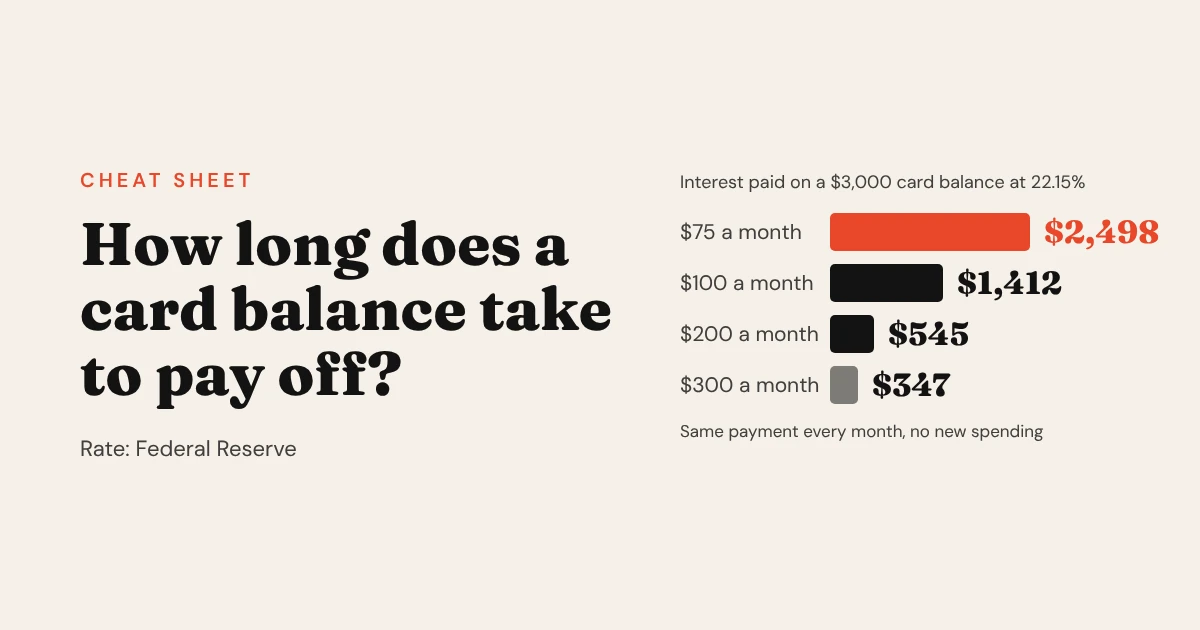
On a credit card, paying a bit more each month saves you a lot. Small payments mostly go to interest, so the debt barely moves. Example: on a $3,000 balance, paying $200 a month instead of $100 saves $866 in interest and gets you debt-free 27 months sooner. The table below shows it, and the spreadsheet check shows it for your own card.
Three words first
- Balance: what you still owe on the card.
- Interest: what the card company charges you for borrowing, on top of what you spent.
- APR (annual percentage rate): the yearly interest rate on your card. 22% APR means that over a year, you are charged about 22% of what you owe, a little each month.
The table: paying off a $3,000 credit card balance
Everything in this table is about the same $3,000 owed on a credit card, at 22.15% a year (the average U.S. rate on credit cards that were charged interest, April to June 2026). No new spending, no fees, the same payment every month:
| Pay each month (on the $3,000) | Months until the $3,000 is gone | Interest you pay on top of the $3,000 |
|---|---|---|
| $75 | 74 (just over 6 years) | $2,498 |
| $100 | 45 | $1,412 |
| $150 | 26 | $779 |
| $200 | 18 | $545 |
| $300 | 12 | $347 |
Read it from the top: at $75 a month, you pay almost as much in interest as you borrowed. Doubling the payment from $100 to $200 saves $866 and gets you out 27 months sooner.
Why the first payments feel useless
Each month, the card first takes its interest on what you still owe. On $3,000 at 22.15% a year, that is about $55.38 in the first month (22.15% ÷ 12 months ≈ 1.85% a month).
So of a $100 payment, $55.38 goes to interest and only $44.62 actually lowers what you owe. As what you owe shrinks, the interest shrinks too, and more of each payment goes to the debt itself. This is compound interest (interest charged on a total that keeps changing) working against you instead of for you.
One more line worth knowing: if your payment is smaller than the monthly interest, what you owe never goes down. On $3,000 at this rate, that line is about $55 a month.
Work out your own number in 30 seconds
You don't need any maths. Open a free spreadsheet (Google Sheets, Excel or Numbers) and type this into any cell, with your own numbers:
=NPER(22.15%/12, -100, 3000)
- 22.15% is your card's APR (from your statement)
- 100 is what you pay each month (keep the minus sign)
- 3000 is what you owe
It answers 44.1, which means 45 monthly payments, the last one smaller. Change the 100 to see how much faster a bigger payment gets you out.
Three things worth checking this week
- Your card's APR. It is printed on your statement, usually near the interest charges. Many cards charge more or less than the average, and it changes the whole table.
- The minimum payment box. U.S. card statements must show how long your current balance takes to pay off if you pay only the minimum, and the monthly payment that clears it in 3 years. Both assume you buy nothing new on the card.
- The interest line. Find how much interest you were charged last month. Compare it with your payment. That one comparison tells you how much of your money is actually lowering the debt.
Why nobody told you this
Most of us learned compound interest as a school exercise about savings, not as the reason a card balance can follow you for years. Reschooled's short video lessons explain how money, debt and interest really work, from the ground up, at reschooled.life.
Sources
- Board of Governors of the Federal Reserve System, Consumer Credit G.19 (released October 7, 2026): interest rate on credit card plans at commercial banks, accounts assessed interest, 2026 Q2: 22.15%. All accounts: 20.94%.
- Consumer Financial Protection Bureau, "A box on my credit card bill says that I will pay off the balance in three years...": issuers must show payoff time at the minimum payment and the payment needed to pay off the balance in 36 months, assuming no new purchases.
- Arithmetic: monthly interest = APR ÷ 12 applied to the remaining balance, fixed payment, no new purchases or fees. Real cards usually charge interest daily, so actual figures differ slightly.
Educational content, not financial advice.